
Mold in Old Gettysburg Homes
Nearly half the houses in the borough were built before 1940, and they handle damp in a way modern houses don't. Here's why the mold keeps coming back in a stone-cellared house, and what to do about it instead.
Why Old Houses Hold Damp
A house built in the 1800s has no damp course. Stone and rubble foundations sit straight on the ground, and moisture climbs the wall by capillary action, which is what people mean by rising damp. The house was designed to cope with it: lime mortar and lime plaster let the wall dry inward, and the cellar was ventilated because it stored coal and vegetables rather than a sofa.
Add a floor over bare soil, a later addition on shallow footings, and a summer where the outside air is warmer than the cellar, and you have every condition mold wants.
That's why basement mold in an old house behaves differently from basement mold in a newer one, and why the same fix doesn't work on both. Stone cellars behave the same way right across the older boroughs, from Littlestown to East Berlin.
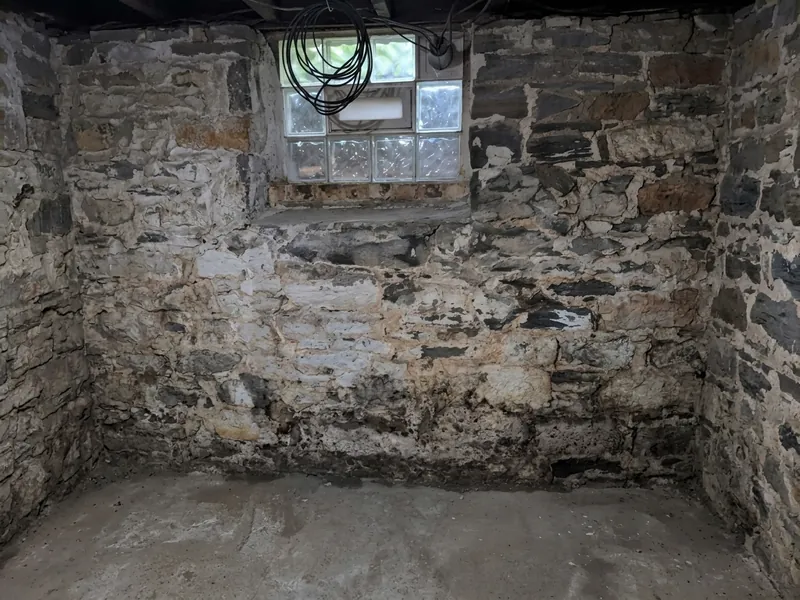
Same wall, every summer?
Tell us how old the house is, what the cellar walls are made of and how long the damp patch takes to dry. Our local mold specialist can tell rising damp from condensation from that, and they'll confirm it on site.
Five Damp Fixes That Make Mold Worse
These five come up every time someone asks how to dry out an old cellar, and every one of them traps water in a wall that was built to breathe.
Waterproof paint on the inside
The same National Park Service that runs the battlefield also publishes the federal guidance on damp in historic buildings, and it's blunt about this. A coating on a damp wall traps the moisture behind it, and with rising damp it pushes the water further up the wall instead of stopping it.
Fiberglass or cellulose against stone
Department of Energy research found it soaks up moisture and stays chronically damp. Nothing dries out behind it.
Plastic sheeting on the inside of a wall
An impermeable barrier traps water inside the wall rather than keeping it out.
A dehumidifier and a vent fan together
Brief 39 warns against it, because you end up pulling dampness out of the walls themselves.
Sealing up the old cellar vents
They're there for a reason, though what suits the house depends on whether the damp is coming up or condensing.
How to Dry Out an Old Cellar
Work through these three in order. Plenty of damp cellars stay damp because someone sealed the wall before sorting out the water outside it.
Outside first
Find the gutters, downspouts and grading first, because with 46.5 inches of rain and snow a year, cellar damp is usually rainwater that never got away from the house. Clear the gutters, run the downspouts well clear of the wall and build the ground up so it slopes away.
Watch before you treat
Give the wall a few months before doing anything to it, which is the first thing Brief 39 asks for. Wet in winter, wet in summer and wet after rain are three different problems.
Then work inside
A perimeter drain and sump take groundwater away. A dehumidifier on a humidistat holds the humidity down. If the wall needs a coating at all, use a breathable lime render, and only sheet a crawl space floor when you're dealing with condensation rather than rising damp.
Why Mold Removal Costs More in a Plaster House
Walk into a house off Baltimore Street or Carlisle Street and the walls are almost never drywall. They are lath and plaster: thin wood strips nailed across the studs, with lime plaster pressed on over the top.
Behind the plaster is a gap, left where the wet plaster squeezed between the strips. Mold gets into that gap and spreads sideways, out of sight. The patch you can see on your wall is rarely all the mold there is, and nobody knows how far it has run until the plaster comes off.
Plaster is slow to take off and slow to put back, so the labor costs more than the same job in a drywall house. Ask any contractor how much they plan to remove and what they will patch it with. Someone used to drywall will often take off half a wall when a few feet would have done.
Repointing causes the same trouble from the outside. These walls were laid in lime mortar, and cement mortar over the top of it traps water in the middle of the wall and pushes it inward. If the paint starts bubbling on an inside wall a few months after a mason has repointed the outside, cement mortar is usually the reason.
Permits for Houses in the Historic District
Gettysburg has had a historic district ordinance since 1972. Exterior changes need a Certificate of Appropriateness before work starts, which now goes in with the Land Use Application ($40), and Adams County wants a Property Improvement Permit for projects over $4,000.
Hiring the contractor has its own rules, set out under choosing a mold company.
Interior mold work doesn't need a COA. Regrading, new gutters and downspouts, adding vents or anything else that changes the outside does, which catches people out when a contractor turns up ready to dig along the foundation.
Before any outside work
Get the certificate
Work done without one can be ordered undone, and you pay for that. Small jobs are sometimes signed off by borough staff between meetings; anything bigger waits for HARB, which meets on the third Wednesday of the month.
Buying or Selling an Old House With Damp
Pennsylvania's seller disclosure law means known water and mold problems have to be declared. What that means in practice is set out under mold inspection for a home sale. In a house from the 1800s, "the cellar has always been damp" is often true, and a buyer still wants to know whether that means an active leak or a wall that has been doing the same thing for a century. Moisture readings answer that.
A written report gives both sides a number to negotiate on instead of a disagreement over a smell. See what that involves under mold inspection and testing, or what clearing it costs under mold remediation cost.
Old House Mold Questions
What is rising damp, and do old Gettysburg houses have it?
Rising damp is groundwater climbing a wall by capillary action, and stone foundations built before damp courses are exactly what it climbs. A telltale sign is a wall that reads wet along the bottom two or three feet and dry above that, often with a crusty white line where the salts come out.
Can I paint or seal my stone basement walls?
Sealing a damp wall traps the water in the stone and can push it higher. Federal preservation guidance says a water-repellent coating should never go on a damp wall. Fix the drainage outside first, then let the wall dry, and use a breathable lime render if it needs a coating at all.
Do I need permission to fix damp on a historic house?
Inside, no. Outside is different: anything that changes the appearance of a building in the Gettysburg Historic District needs a Certificate of Appropriateness before work starts, and that includes gutters, downspouts, vents and regrading along the foundation.
Can mold be cleaned off old plaster?
Sometimes, when it is only on the surface and the wall is dry. The trouble is that plaster soaks moisture up and mold runs along the lath behind it, so what looks like a small patch often is not. Moisture readings show how far it has gone before anyone starts cutting.
Get a mold removal estimate
Tell us how old the house is and where the damp shows up, and our local mold specialist will come back to you the same day. Mold under the floor or up in the roof as well? See crawl space and attic mold, or find your town on the areas covered page.
Call now (223) 747-0678 Mold remediation in Gettysburg and Adams CountySources: LimeWorks on cement mortar and historic masonry, NPS Preservation Brief 39, Controlling Unwanted Moisture in Historic Buildings, NPS Preservation Brief 1, water-repellent treatments, US Department of Energy, Building America basement insulation research, Gettysburg Borough HARB, Gettysburg Borough permits, PA Real Estate Seller Disclosure Law, U.S. Census Bureau, ACS 2023 housing data, NOAA NCEI, 1991–2020 Monthly Climate Normals, Gettysburg 4.9 SW, PA (US1PAAD0012).